When You Raise a Concern and Become the Problem: Understanding DARVO
When You Raise a Concern and Become the Problem: Understanding DARVO
Have you ever tried to bring up something that hurt you, only to find yourself apologizing ten minutes later? You walked in with a concern about their behaviour, and you walked out wondering whether you were the problem.
If so, you're not alone, and there's a name for what may have been happening: DARVO.
What is DARVO?
DARVO stands for Deny, Attack, Reverse Victim and Offender. Jennifer Joy Freyd, PhD. coined the term. It describes a pattern that can show up when someone is held accountable for harm:
Deny: they dispute that it happened, or that it was a problem.
Attack: they go after the person raising the concern, questioning their motives, character, or memory.
Reverse Victim and Offender: they recast themselves as the one who has been wronged, and the person who spoke up becomes the problem.
When someone's held accountable, the spotlight moves, and you become the problem.
Defensiveness is natural. A pattern is different.
I want to be clear about something, because I work with couples every day. Defensiveness is a natural human reaction to conflict. It's not a positive one, yet almost all of us get defensive sometimes, and on its own it doesn't make someone a bad partner.
What changes things is pattern. When denying, attacking, and flipping the story happens again and again, in different rooms and over different issues, it stops being a moment of defensiveness. It becomes a way to protect someone's actions and intent by shifting the focus onto you. At its worst, it's a manipulation tactic, and it can become coercive.
Why it's so hard to catch
DARVO rarely announces itself. The moves start small, then grow. A joke that stings. A comment that shrinks you a little. Because humour is involved, and especially when your humour matches, it's easy to laugh it off. Each time you do, your boundary gets a little smaller.
It's also hard because it happens in real time, when you're emotional. You came in clear about what happened, and somewhere in the conversation you lost the thread.
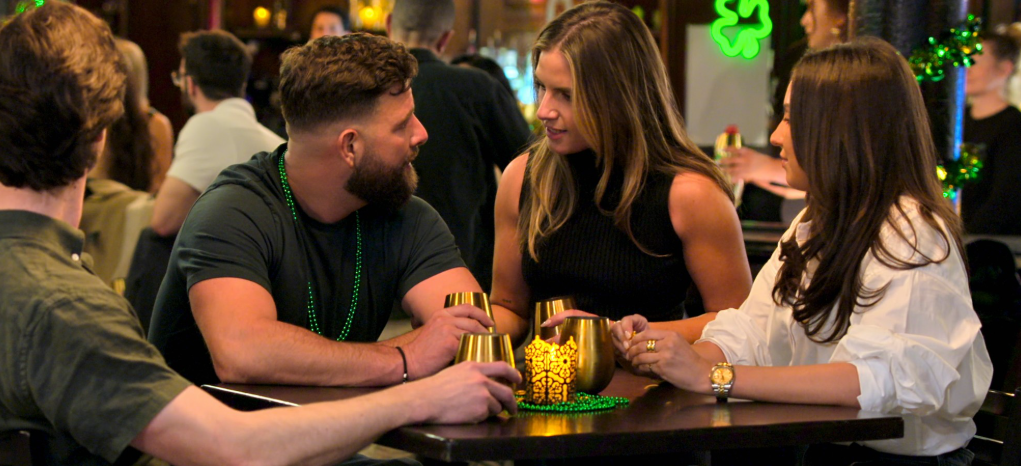
A case study: what many of us saw on Love Is Blind
A quick disclaimer: this is reality TV. We've only seen a few minutes of anyone's life, and it's edited. I can't know what's in anyone's heart, and I'm not diagnosing anyone. What I can do is describe a pattern, because I'd encourage you to look for patterns in your own life.
In Season 11, many of us watched Michaela and Rob. Here's what stood out to me, in stages.
Stage 1: The small tests
Early on, there was the "dud" joke, the kind you laugh off because your humour matches. There was the moment he told her not to wear orange around his mom, while she was wearing an orange jumper. Tiny moments like these teach you that your comfort is negotiable. In my read, they also came up more when he seemed uncomfortable or ashamed, as if feeling down showed up as tearing her down. I go back to the time when he told her not to wear orange in front of his mother. This was right after his pottery didn't turn out as well as hers. His demeanour shifts slightly here, giving us insight into how he acts when he feels "less than" or discouraged.
Stage 2: His friends
Before they met his friends, he warned Michaela it would be hard. She's someone who accepts a challenge, so in a way that primed her for it. Then he behaved poorly around his friends, and she was left in what looked like a scary spot. She handled it with grace.
But when it came time to talk about it, the conversation didn't stay on what he did. Her intentions were questioned, and it was suggested that she benefits from being on the show. The spotlight moved to her.
Michaela speaks about being mentally and emotionally exhausted after coming back on screen when her intentions were questioned. The DARVO experience is confusing and exhausting.
Stage 3: The group hangout
Same pattern, new setting. After Michaela left to cry, Rob read her as jealous of Diana. Once again, the issue wasn't his behaviour in his eyes. It was her supposed insecurity. And this is even though everyone in the room had felt uncomfortable long before that conversation.
Different rooms, same move: protect his actions and intent by turning the focus on her.
What Michaela did
This is the part I find most inspiring. Michaela didn't take the bait. She didn't confess to an agenda or an insecurity she didn't have. She felt her feelings, stepped away to cry, came back, and stayed on what she saw. Then she made a clear decision. She also stayed on the behaviour and avoided blaming the person.
That's what steadiness looks like. Staying on what you saw doesn't mean you stop being kind. It means you stop letting someone else rewrite your experience.
How to tell if this is happening to you
Ask yourself:
When I raise a concern, does the conversation turn to my motives, my intentions, or me?
Do I leave conversations confused about what we were even talking about?
Am I apologizing for bringing something up?
Does the same thing happen across different topics and different settings?
Do I find myself rehearsing how to bring something up so it doesn't "blow up"?
One more pattern to watch for: the conversation afterward where it becomes, "Let's unpack your intentions. There's something deeper going on for you." Therapy-style language can be used to avoid the real issue. If a conversation about what happened keeps turning into an analysis of you, notice that.
What you can do
Stay on the original issue. "I'm not talking about my motives. I'm talking about what happened."
Keep it short. Long explanations give more to pick apart.
Don't confess to something you didn't do. You can acknowledge a real impact without accepting a false story.
Keep your own record. A few notes in your phone help when your memory is being questioned.
Check in with someone you trust. A friend, a counsellor, someone who isn't in the dynamic.
Look at the pattern, not just the moment. One conversation can be a bad night. A pattern across settings tells you something.
A word about safety
The tips above are for conflict. Conflict is not the same as danger. If the person in your life reacts with anger, particularly when drinking, ask yourself honestly: Am I safe? Do I walk on eggshells? Do I change what I say to avoid their reaction? Am I afraid?
If the answer is yes, this isn't a communication problem to solve on your own. Tell someone you trust, make a plan, and reach out for support. In BC, VictimLinkBC is available 24/7 at 1-800-563-0808.
You're not overreacting
If you read this and your stomach dropped, you're not overreacting. This happens more than we think, and it's hard to see from the inside. Naming it is the first step toward standing on solid ground again.
If this felt familiar and you'd like support making sense of it, we'd be glad to talk. You can book a conversation with us.