
Stress vs. Anxiety: What You Can Do
Stress vs. Anxiety: What's Happening in Your Brain, and What You Can Do
Not every spiral is anxiety, and not every worry is 'all in your head.' Knowing the difference between stress, anxiety, and a real problem that needs support changes what you do next.
Stress isn't an event. It's a collision.
The same deadline, argument, or sleepless night lands very differently on different people. That's because stress isn't the event itself. It lives where three things meet: meaning, perception, and our ability to cope.
Psychologists Richard Lazarus and Susan Folkman described this in their 1984 book, Stress, Appraisal, and Coping. In their transactional model, we first ask what's at stake, then whether we have what we need to handle it. Stress arises when a situation's demands seem to exceed our capacity to deal with them.
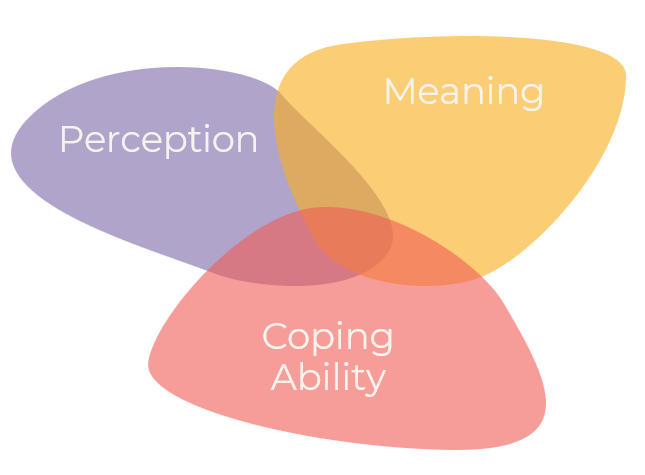
Picture a Venn diagram. One circle is your perception of the situation causing the stress. Another is the meaning you give the situation. The third circle is your coping ability: your energy, sleep, support, skills, and time. Stress sits in the overlap. Change the meaning, or change the capacity, or the person experiencing the stress, and the same event feels different. That's not weakness. It's two people with two different overlaps.
Stress or anxiety? A quick way to tell
Stress | Anxiety | |
|---|---|---|
Source | A clear, present demand | An anticipated or imagined threat |
Proportion | Matches what is in front of you | Often bigger than the situation |
When you act | Eases when you deal with the problem | Lingers or spirals, even after it's handled |
Focus | What is happening | What might happen |
Two questions can help you identify whether this would be considered stress or anxiety.
Is this feeling proportionate to what's actually in front of me?
And does it settle when I take action?
If yes, it's likely stress. If it keeps going without an obvious reason, anxiety may be taking over.
This is a rule of thumb, not a diagnosis. Anxiety can have a real trigger too. If worry is constant, hard to switch off, or getting in the way of your life, a professional assessment is worth having.
Anxiety often grows when the meaning gets bigger while your felt ability to cope gets smaller.
Where anxiety comes from
Anxiety and panic attacks rarely have a single cause. They can stem from a combination of genetic, biological, psychological, and environmental factors, including stress, health issues, and past trauma.
• Genetic: Anxiety can run in families, and twin studies suggest genetics play a role.
• Biological: Brain chemistry and the brain areas that process fear, like the amygdala, are part of the picture. Some medical conditions, medications, and substances like caffeine or alcohol can also trigger or amplify anxiety, which is why it's worth ruling out a medical cause with your doctor.
• Psychological: Habits of thinking, like expecting the worst or worrying in loops, can keep anxiety going.
• Environmental: Ongoing stress from work, relationships, or money, and past experiences like trauma or childhood instability, can prime your nervous system to stay on high alert.
The honest summary is that the exact causes aren't fully known. According to the National Institute of Mental Health, as summarized by Healthline, a combination of genetic and environmental factors may play a role, and brain chemistry is still being studied.
But this means that anxiety isn't a character flaw or a failure to think positively. It's usually vulnerability meeting circumstance. If it's persistent, disrupts your daily life, or leads to relying on substances to cope, that's a good reason to seek professional support.
Anxiety and the need for control
Underneath a lot of anxiety is a question: can I control what happens? Much of anxiety lives in uncertainty, the gap between what we know and what might happen, and whether we feel we could handle it.
Research on intolerance of uncertainty, the tendency to react negatively to uncertain situations, has proposed it as an important maintaining factor in several anxiety disorders, including generalized anxiety, OCD, and social anxiety.
Control also shows up in what we do about anxiety. Worry is thought to ease distress over uncertainty by giving us, at least, a sense of control over future outcomes, and compulsions in OCD work in a similar way. Over-planning, checking, avoiding, and rehearsing worst cases can all feel like control. They may bring short-term relief, but they also keep us from learning that we can cope with uncertainty.
The sense of control matters in the other direction too. A meta-analysis found that feeling more control over your emotions and over threats goes with fewer anxiety symptoms across anxiety disorders, and changes in perceived control may predict how well CBT works. Fear of losing control may also play a role in multiple anxiety disorders.
Notice that the brain research below is about uncontrollable stress. How much control we feel matters, psychologically and biologically.
So a more useful question than 'How do I make sure nothing goes wrong?' is 'What's within my control right now?' We can't control the outcome, but we can often control our next step, our response, who we ask for support, and how we care for ourselves. Planning your break ahead of time, which we'll get to shortly, is one small, real piece of control you can build in advance.
What happens in your brain when you spiral
When your brain reads something as a threat, your body mounts a stress response. Adrenaline and cortisol rise, and your heart speeds up. Anxiety activates your autonomic nervous system, which raises your heart rate, and during a panic episode it can climb past 100 beats per minute, the clinical threshold for tachycardia.
At the same time, your prefrontal cortex, the part of the brain that plans, weighs options, and keeps emotions in check, becomes less effective. Yale neuroscientist Amy Arnsten's 2009 review in Nature Reviews Neuroscience found that even fairly mild uncontrollable stress rapidly impairs prefrontal function in animals and humans, while the same chemical shifts strengthen the amygdala's emotional operations. A Scientific American piece by Arnsten and a colleague explains that acute, uncontrollable stress weakens the prefrontal cortex's influence while older brain areas take a stronger hold. When stress is sustained for days or weeks, the effects can become structural, with prefrontal branches shrinking and amygdala branches growing.
A caveat: much of the detailed mechanism comes from animal research, with human studies pointing the same way.
The practical translation is simple. In the middle of a spiral, your best thinking tools are harder to reach. That's biology, not a character flaw.
A note on the 'amygdala hijack'
You may have heard this phrase. Daniel Goleman coined it in his 1995 book, Emotional Intelligence, and it's a popular psychology metaphor rather than a precise scientific model. Newer research suggests the amygdala and prefrontal cortex mostly work together rather than in conflict, that there is no single fear center in the brain, and that intense emotion is often shaped by how we interpret a situation, which involves the prefrontal cortex.
But what we see is that stress dials down your thinking brain and turns up your alarm system. It doesn't switch your logic off. The metaphor can still help describe the experience, as long as we hold it loosely.
Why a break comes before problem-solving
If your thinking brain is less available, trying to solve the problem mid-spiral can lead to going in circles. So give yourself a break first. A puzzle, a word game, or a walk with a friend where you talk about anything but the worry. A break also gives you a chance to check whether the issue is actually urgent. Often it can wait until you've settled.
Pulling what we know about our brain forward, we know that mid-spiral is not the time to think about what we should do to take our mind off our anxiety. Plan your break ahead of time. Decide now what you'll do, where, and with whom, so you're not trying to figure it out in the middle of a spiral.
Before you call it anxiety, ask what's happening in the moment
Sometimes it isn't a thinking pattern at all. It's a gap. Not enough sleep. Not enough help. Money pressure. Isolation. A health concern that deserves a proper check. If your coping capacity is genuinely low, then stress is a reasonable response to a real gap, and calling it anxiety can mean the actual problem goes unaddressed.
Try asking three things. What's actually true here? What's real? And what support would close the gap?
For new and expecting parents
This matters most in the postpartum period. The demands are real: sleep deprivation, physical recovery from birth, feeding challenges, isolation, financial pressure, and sometimes a baby with a genuine medical need. Some vigilance about your baby's safety is also normal and protective.
Postpartum anxiety is different. The Women's Mental Health resource hub describes it as constant, excessive, and hard to turn off, often with tension, trouble sleeping, or panic attacks. It's also easy to overlook: some studies indicate clinically significant anxiety symptoms are as common as postpartum depression, or more so.
Unwanted thoughts or images of harm coming to the baby are common in postpartum anxiety. They feel upsetting and 'not me,' and having them doesn't mean a parent will act on them, but they are distressing and a good reason to seek support.
Consider reaching out to your doctor, midwife, or public health nurse if you notice:
Worry that feels constant and hard to turn off
Not being able to rest even when the baby is asleep
Panic, racing thoughts, or intrusive thoughts
Anxiety that is getting in the way of sleep, caregiving, or daily life
Get urgent help if you have thoughts of harming yourself or your baby, feel you might act on them, can't care for yourself or your baby, or notice symptoms that suggest postpartum psychosis. Call emergency services, or call or text 9-8-8 in Canada.
Postpartum anxiety is common and treatable, and you don't have to wait until it feels unmanageable to ask for help.
Your Feelings are information
Sometimes they point to a thought pattern. Sometimes they point to something real that needs your attention and support. You deserve help sorting out which is which.
If you'd like to talk it through, you can book a conversation with me. And if you're expecting or have just welcomed a baby, I have a free online course for new parents, and a live webinar series supports you where you are. The webinar launches April 2027, but the waitlist is open now.